A buyer touring Lake St. Louis this summer will hear the same pitch on nearly every showing: private lakes, marinas, a clubhouse, golf. What that buyer often does not hear until much later, sometimes after an offer is already in, is that the house two doors down the same street might carry none of it. Lake access here does not follow the city limits. It follows the deed.
That distinction is the whole story. Most comparisons of this market treat "lake community" as a single product with a single premium. It is not. It is two physically different lakes, each with its own rulebook, sitting inside a membership system that attaches to specific parcels rather than to an address. Understanding that structure, not the view from the dock, is what separates a buyer who gets what they expected from one who finds out at closing that they did not.
Your Address Doesn't Decide This. Your Deed Does.
The Lake Saint Louis Community Association, known locally as the LSLCA, owns and administers the lakes, marinas, clubhouse, and golf courses. Membership and the amenity rights that come with it are established through recorded covenants on the property, not through the municipal boundary. A home can sit fully inside the City of Lake Saint Louis and still fall outside the LSLCA, which means it carries no lake rights at all despite the address.
Some properties add a second layer on top of that: a separate Area Association that manages neighborhood-level landscaping or architectural rules in addition to the main community association's authority. That means a buyer needs to know not just whether a home has lake rights, but whether it is paying into one layer of dues or two. This is not a detail you can eyeball from the street. It shows up in the recorded declaration, and it is the first thing to confirm before you get attached to a listing photo of a dock.
Two Lakes, Two Rulebooks
Once lake rights are confirmed, the next question is which lake. Lake Saint Louis, the larger of the two and the one most people picture when they hear the name, covers roughly 600 acres. Its neighbor, Lake Sainte Louise, covers well under a fifth of that. Locals shorthand them as the big lake and the small lake, and the nicknames are doing real work, because the two bodies of water are governed by different rules.
The big lake permits higher boat speeds, runs a counterclockwise traffic pattern, and maintains no-wake zones in specific areas. The small lake caps motors at 10 horsepower and bans certain watercraft outright. That single regulatory difference reshapes who buys on each lake. Families who want to ski or tube gravitate to the big lake. Buyers who want quiet paddling and fishing without a wake rolling past their dock look at the small lake instead.
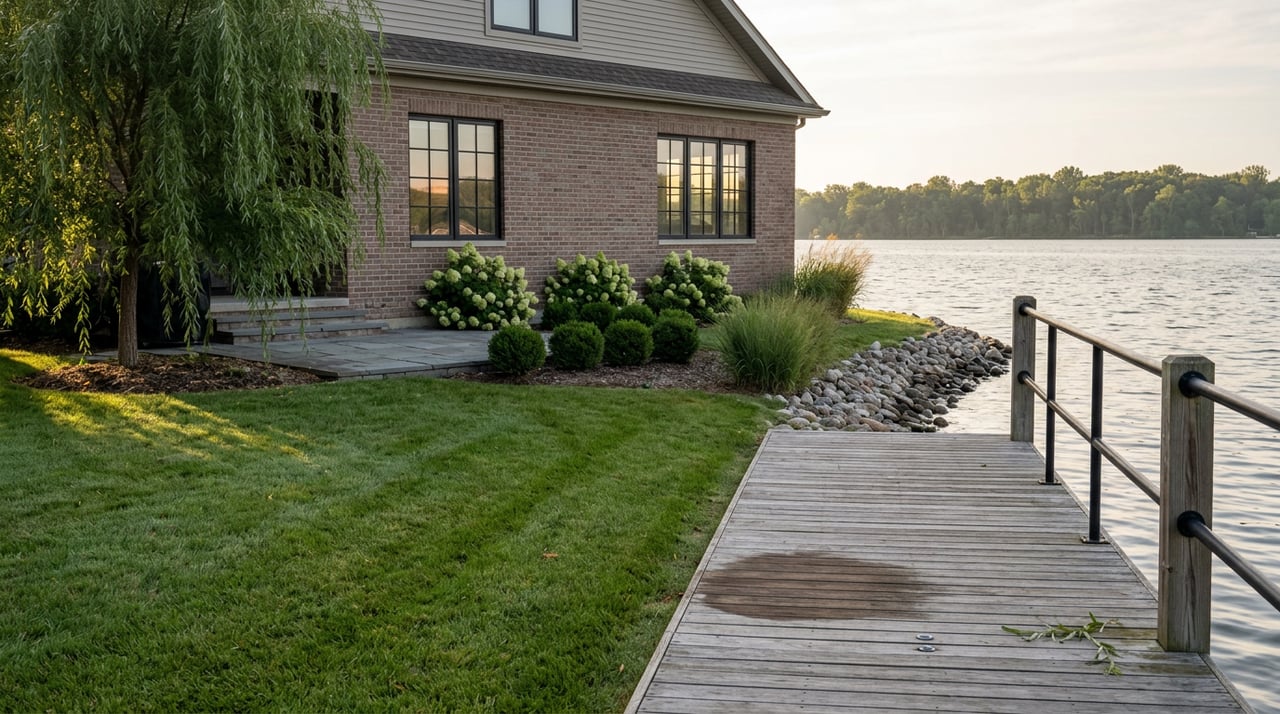
Lot geography follows the same split. Big lake waterfront ranges from compact shoreline parcels up to properties approaching an acre, and many of those lots slope down to the water with steps cut into the yard. Small lake lots tend to be flatter. The big lake also carries more of the community's established subdivisions, names that show up again and again in listings: The Moorings, Regatta Bay, Ravens Pointe, Key Harbour.
| Lake Saint Louis (the big lake) | Lake Sainte Louise (the small lake) | |
|---|---|---|
| Approximate size | About 600 acres | Well under a fifth of that |
| Motor and speed rules | Higher speeds allowed, counterclockwise traffic pattern, marked no-wake zones | 10 HP motor cap, certain watercraft banned |
| Typical waterfront lot | Compact to nearly an acre, often sloped with steps to the water | Mostly flat |
| Known subdivisions | The Moorings, Regatta Bay, Ravens Pointe, Key Harbour | Smaller footprint, fewer established waterfront subdivisions |
The rulebook, not the water, is what a lake premium is actually pricing in.
The Real Price Tag Is the Waitlist
Here is the part that rarely makes it into a listing description. Residents who do not own waterfront can still register a boat and rent a slip at the community marina, but the waitlist for a slip has reportedly run for years for some households. That single fact reframes what a waterfront lot is actually selling.
It is not selling a better view. It is selling the ability to skip a line that other members are stuck in indefinitely. When a resource like marina space is fixed and demand keeps growing, a community has two ways to allocate it: price or time. Lake St. Louis uses both. Non-waterfront owners pay modest annual fees and then wait. Waterfront owners pay a much larger amount upfront in the purchase price and skip the wait entirely, provided their private dock does not exceed 30 percent of their shoreline, the limit the association enforces on dock size.
That scarcity is not temporary. Nearly all of the waterfront lots on both lakes have already been developed, and no new construction is happening directly on the water. Some homes on the lake date back to the 1970s. The supply of waterfront parcels is effectively fixed, which means the premium buyers pay for that lot is not really a bet on appreciation. It is closer to a one-time toll for permanent access to something the association is not making more of.
What Ownership Costs After You Close
The LSLCA's 2026 fee schedule gives a concrete sense of what a household budgets for beyond the mortgage. The annual community assessment for 2026 was 650 dollars per property, due March 1 of this year, and it applies evenly across detached homes, attached homes, villas, and condo units within LSLCA boundaries. That figure covers membership itself, not activity.
Recreation is billed separately and by use. Golf runs 11 dollars for 9 holes and 16 dollars for 18 for members, with guest rates at 15 and 20 dollars. Pool access is 7 dollars for members and 8 for guests. Tennis and pickleball follow the same member and guest split. For boat owners, the 2026 schedule lists registration ranging from 31 dollars up to 327 dollars depending on boat class, with a typical marina dock slip renting for 578 dollars for the April to March season. A boat lift in some sections runs 444 dollars with an 825 dollar lift deposit.
None of these numbers is large on its own. Added together across a boating household that also uses the pool and plays golf a few times a month, they become a real annual line item that a buyer moving from a neighborhood with no HOA at all needs to plan for, on top of whatever separate dues apply to their specific subdivision.
Before You Write the Offer
A handful of checks before an offer goes in will save weeks of confusion later.
- Ask the listing agent to confirm, in writing, whether the property carries LSLCA lake rights, and request the recorded covenant language rather than relying on the address.
- Identify which lake the property is associated with and whether that matches the buyer's actual use case, whether that is watersports or quiet paddling.
- Ask whether the property sits in a separate Area Association in addition to the main LSLCA, and get the combined dues total, not just one figure.
- If waterfront access matters, ask directly about current marina slip waitlist length rather than assuming a slip comes with membership.
- For any waterfront parcel, confirm dock size against the 30 percent shoreline limit and ask whether floodplain review applies to the specific lot.
FAQ
Does living inside the city limits of Lake St. Louis guarantee lake rights? No. Lake rights come from the recorded covenants on a specific property, not from the municipal boundary. A home can be inside the city and outside the LSLCA at the same time.
Can a buyer get on the marina waitlist before closing? Boat registration and slip requests go through the LSLCA and generally require current membership standing, which means they follow, rather than precede, closing on a qualifying property.
Is the small lake cheaper because of the 10 horsepower limit? The motor cap shapes who wants to live there more than it directly sets price. Buyers drawn to quiet paddling and fishing over watersports often prefer the small lake regardless of cost, and lot geography there tends to be flatter rather than sloped, which is its own separate factor in value.
Whether you are trying to figure out which lake actually fits how your household spends a weekend, or you are selling a home here and want it marketed with the specifics that actually move a buyer, this is the kind of detail that separates a smooth closing from a surprised one. The team at Reed-Koppel Collective works this market street by street, deed by deed. Get your free home valuation and let's talk through exactly what your property carries before it ever hits a listing.